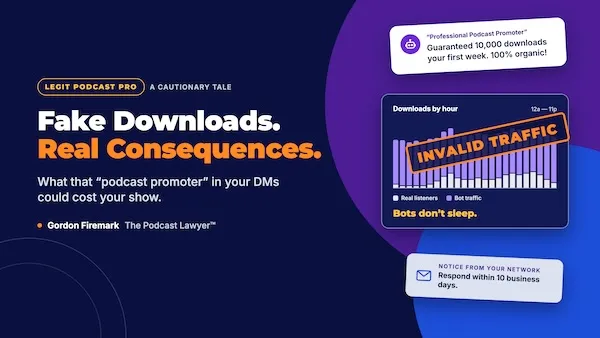
Fake Downloads, Real Consequences: What That "Podcast Promoter" Could Cost You
Fake Downloads, Real Consequences: What That "Podcast Promoter" Could Cost You
The short answer: Paying a "podcast promoter" that guarantees downloads, rankings or reviews can put your show in breach of your network, hosting and advertising agreements, even if you never knew the promoter used bots. Networks and hosts can spot artificial traffic, and the fallout can include clawed-back ad revenue, a terminated deal and possible FTC exposure. Ask every promoter, in writing, exactly how they get you listeners, and put a no-bots promise in your contract.
Key facts
Question | Answer |
|---|---|
What is a "podcast promoter" scam? | A paid service promising guaranteed downloads, chart rankings or reviews, often delivered by bots, data-center traffic or incentivized auto-downloads. |
Who is responsible if the promoter cheats? | Usually you. Network and hosting agreements typically make the podcaster responsible for traffic tied to the show, including what third parties do on its behalf. |
How do networks catch it? | Server logs show telltale patterns: traffic from a few corporate or data-center networks, a flat around-the-clock rhythm, and outdated app versions. |
What federal rule applies? | The FTC's rule on consumer reviews and testimonials (16 CFR Part 465) bans buying fake reviews and fake indicators of influence like views, plays and followers. |
Maximum FTC civil penalty | Up to $53,088 per violation (the 2025 figure, which remains in effect for 2026). |
Platform consequences | Removal from ad programs, removal from hosting, or artificial plays stripped from your stats. |
Safe alternatives | In-app promotion, cross-promotion and feed drops with real shows, and ordinary paid advertising you can track. |
A letter no podcaster wants to open
A podcaster came to me recently with a letter from the network that carries their show. It was polite, firm and very serious.
The network's platform had reviewed several months of download data. Its conclusion: most of the show's downloads didn't look like real people listening. They came from a handful of corporate and hosting networks. They arrived at a steady clip, day and night, with none of the commute-and-evening rhythm real audiences have. And they ran on app versions years out of date.
The network wanted answers within ten business days. It wanted a signed statement that nobody had bought fake downloads. It wanted a list of every promoter, agency and growth service the podcaster had used, with contracts and invoices. And it reminded my client, in so many words, that it was reserving all its rights.
Here's what had actually happened. A few months earlier, my client got a message from a "podcast promoter" offering to grow the show. The pitch sounded professional. The price seemed reasonable. The numbers went up. My client thought it was working.
It was working. Just not the way anyone wanted.
How "guaranteed growth" usually works
Real listeners can't be guaranteed. People choose what they listen to. So when a service promises a specific number of downloads, a chart position or a batch of five-star reviews, it's usually delivering one of these instead:
Bots and scripts that request your episode files from servers in data centers.
Incentivized installs, where people in mobile games or reward apps get points for "subscribing" to a show they'll never hear.
Auto-download farms of old phones or emulators set to download every new episode.
Fake ratings and reviews from accounts that aren't real listeners.
The numbers on your dashboard rise. Your actual audience doesn't. Hosting platform RSS.com puts it bluntly: when fake downloads occur while ads are running, advertisers are paying for listens that never happened, and that's ad fraud.
Why the network noticed
Podcast downloads are counted from server logs, and the industry has a standard for doing it. The IAB Tech Lab's Podcast Technical Measurement Guidelines (most recently updated to version 2.3 in 2026) require certified hosts and measurement companies to filter bots and to document how they handle anomalies, like unexpected spikes from single sources.
Most artificial traffic leaves fingerprints. The review in my client's case pointed to three, and they're the same ones you'll see again and again:
Where it comes from. Real people listen on home Wi-Fi and phone networks. Bot traffic tends to come from corporate or cloud-hosting connections, packed into a small number of address blocks.
When it comes. Real listening rises and falls through the day. Automated traffic is flat, around the clock.
What it runs on. Real listeners update their apps. Download farms often run old, frozen app versions.
Any one of those can have an innocent explanation. All three together, overlapping almost perfectly, is very hard to explain away. Here's the telling detail: when the network set that traffic aside, what remained looked like a modest, normal, genuine audience. My client had real fans. The promoter had buried them.
"But I didn't know." Why it's still your problem
This is the part that surprises podcasters most. You may not have known how the promoter got its numbers. That doesn't automatically get you off the hook.
Your contracts. Network, hosting and ad-sales agreements typically require that your audience be genuine and make you responsible for activity tied to your show, including what people you hire do for you. RSS.com's policy, for example, says the podcast owner is responsible even if a third party did it or the owner didn't know. Breach can mean clawed-back revenue, withheld payments, make-goods to advertisers, termination and, in some deals, indemnity for the network's losses.
Federal law. Since October 2024, the FTC's Rule on the Use of Consumer Reviews and Testimonials has made it an unfair or deceptive practice to buy fake indicators of social media influence, such as views, plays, followers and likes, when you knew or should have known they were fake and they misrepresent your influence for a commercial purpose. Buying fake reviews is banned too. The maximum civil penalty is $53,088 per violation. "Should have known" matters here. A pitch promising 10,000 downloads in a week is the kind of thing a regulator may say you should have questioned.
To be fair about the limits: private download numbers in a media kit aren't a perfect fit for the rule's definition, which focuses on metrics the public uses. But reviews, ratings, public play counts and chart positions fit squarely. And showing a sponsor inflated numbers raises deception and contract problems on its own.
Platforms. Platforms have their own rules. RSS.com removes shows caught with fake traffic from its ad program, and removes them from hosting if it continues. Spotify strips artificial plays from public counts and charts.
Your reputation. Ad buyers talk. Once a show is flagged, it's hard to sell inventory at a fair rate, even after the fake traffic stops.
If you get a letter like this
Don't panic, and don't ignore it. Do these things, in roughly this order:
Call a lawyer before you sign anything. The letter may ask you to sign a statement. Make sure every word of it is true and that you understand what you're admitting.
Preserve everything. Emails, DMs, invoices, payment records, dashboards and screenshots. Don't delete the promoter's messages, even embarrassing ones.
Stop the campaign, in writing. Tell the promoter to cease all activity on your show, and keep a copy.
Gather the paper trail. Who you hired, when, what they promised, what you paid and what they said they'd do.
Lock down access. Change hosting passwords and revoke any access the promoter had to your feed, files or accounts.
Respond fully and on time, through or with your lawyer.
A podcaster who was misled by a vendor, comes forward and cleans things up is in a very different position from one who stonewalls.
How to vet a podcast promoter
Not all paid promotion is a scam. There are good options. But vet them the way you'd vet any business partner.
Red flags:
Guaranteed downloads, rankings, subscribers or reviews.
"100% safe" or "100% organic" claims with no explanation of method.
Cold DMs and copy-and-paste pitches.
Prices that look too good for the numbers promised.
Requests for your hosting login or RSS feed control.
Vague answers when you ask exactly where listeners will come from.
Put these in writing before you pay:
A method disclosure. Exactly where and how your show will be promoted, to real people.
A no-bots promise. No bots, scripts, VPN or data-center traffic, incentivized installs, auto-download tools, or paid reviews.
Compliance with your other deals. Nothing that would violate your network, hosting or platform terms.
Indemnity. If the promoter breaks those promises, it covers your losses.
Reporting. Where the campaign ran, how many impressions, what it cost.
An off switch. You can stop the campaign immediately, in writing.
If a promoter won't sign a simple promise that it won't use bots, you have your answer.
What real growth looks like
Legitimate paid growth tends to fall into a few buckets: promotion inside podcast apps, where people are already looking for shows; cross-promotions and feed drops with shows whose audiences overlap with yours; and ordinary advertising (display ads, newsletters, sponsored posts) that you can measure. It's slower. It's also real, and real listeners are the only ones who buy from your sponsors.
If you're building a show you want to monetize, the agreements underneath it matter as much as the growth plan. My Easy Legal For Podcasters membership includes vendor and contractor agreement templates, plus a community where you can ask before you sign: https://easylegalforpodcasters.com. And if you've already received a letter like this one, reach out and schedule a consultation with me.
Frequently asked questions
Is it illegal to buy podcast downloads? It can be. Buying fake views, plays, followers or reviews you knew or should have known were fake violates the FTC's consumer reviews rule when they misrepresent your influence for a commercial purpose. Even where the rule doesn't reach, inflated numbers usually breach network, hosting and ad agreements.
Can a podcast network terminate my deal over fake downloads? Often, yes. Most network agreements require genuine audience numbers and give the network remedies for invalid traffic. Read your agreement's warranties, termination and indemnity sections, or have a lawyer do it.
What if my promoter used bots without telling me? You may still be responsible under your contracts, and "should have known" is the FTC standard. Lack of knowledge helps, especially if you stop immediately and cooperate, but it isn't a complete defense.
How do networks and hosts detect fake podcast downloads? They analyze server logs for patterns like traffic concentrated in corporate or data-center networks, a flat around-the-clock download rate and outdated app versions. Hosts certified under the IAB Tech Lab guidelines filter known bots and document how they handle anomalies.
Are any paid podcast promotion services legitimate? Yes. In-app promotion, cross-promotion with real shows and standard paid advertising can bring real listeners. Ask any provider in writing how it reaches listeners, and get a no-bots promise in the contract.
What should I do if I get a demand letter about invalid traffic? Don't ignore it, preserve all records, stop any promotion campaign in writing, and talk to a lawyer before you sign any statement or respond.
Last reviewed: November 6, 2026.
Gordon Firemark is The Podcast Lawyer™, an entertainment and media attorney in Los Angeles with 34 years of experience helping podcasters and media businesses protect what they build. This article is general information, not legal advice. Details of the client matter have been changed to protect confidentiality.
Attorney Advertising
